

The following is a short story written for the benefit of 7th graders as they progressed through their Language Arts Program. The purpose of this story was to help my students see the elements of the narrative arc, the structure of all renowned and remembered stories, in the form of a very brief fictional composition. To that end, there were a variety of footnotes for reading comprehension and guiding questions to assist a deeper analysis of the text. However, I have removed these footnotes in this published version. I hope my readers here can enjoy it as well.
Questions to consider while reading the story:
Does the story follow a narrative arc with an exposition, rising action, climax, falling action, and resolution?
Can you identify where those structural elements are in the story?
Where does the story feel rushed? Where does it feel like it drags?
What are the major themes within the text?
Theme: Life lesson, meaning, moral, or message about life or human nature that is communicated by a literary work.
In other words...The theme is what the story teaches readers.
What is the central conflict within the story?
What problem does the protagonist face and how does he face it?
What literary techniques are used to develop the character of the protagonist?
In what perspective is the story written?
How do we come to know the protagonist?
Are you able to describe the kind of character the protagonist is according to his appearance, thoughts, feelings, reactions, and actions?
N.B. Feel free to annotate the text. Take notes, highlight, define key terms, etc.
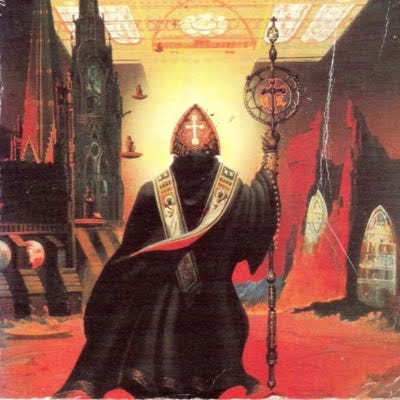
Evangelion
We knew they were there, and they knew we were coming, thought the young monk. The expedition to the far reaches of the galaxy was undertaken without the sanction of the New Colonial Monarchy, nor had Christoff’s Augustinian superiors given a canonical mission, besides the tacit approval of the prior. But the lack of approval ensured a quiet, underwhelming departure for the E Class Voyager into the vacuous oceans of space.
That dark abyssal night lay just beyond the ceramic walls of the hull, and perhaps closer to Christoff’s cold face than comfort would have preferred as he searched out the port window. Christoff had discarded his habit for a simple tunic designed specifically for religious orders to wear outside Earth’s atmosphere. It was made of tight-fitting fabric, colored all black besides the brown belt at the waist. Spots and specks of light out the window, though more abundant than any sight from the surface of Earth, impressed on the young monk the deepest sense of distance. Light touched light only after traveling light-years by the millions and billions, and in the interim swam the quantum churning, imperceptible to the eyes. As he stared, Christoff thought about that emptiness beyond the thin walls. He had always wanted to doubt the scientific consensus that sound could not travel through a vacuum, in the vain hopes that the ancient term “the music of the spheres” might have some purchase in physical expression. He hoped that analogical expression might manifest literally as harmonious, resonant vibrations against the ship’s outer walls. He wanted to hear the music. If St. Paul’s “third heaven” referred to the supranatural kingdom of God, then perhaps the second heaven might include a glorious symphony of astral music simply waiting for ears that could hear it. Christoff listened in all that stillness, but all he could hear were the vibrations of the engines at the rear of the spacecraft and the low, consistent beeps and chirps of the computers, not the music of God’s stars singing a hymn. Qui habet aures audiendi, audiat.
Idle fancies all, thought the young religious.
Such thoughts would often take space in his mind, and they left him sometimes with the brief consolation he apprehended as grace, or more often, a grander sense of his mind and its ability to think wonderful thoughts. After all, he had much time to think, to muse, and wander the caverns of his own mind. The journey would be long, but in all the history of those legendary bearers of the Good News, Christoff felt no different from his predecessors, though he climbed the waves of night past burning suns and meteoric wanderers. The thought satisfied him immensely.
He had been warned by Fr. Cassius after compline the Sunday before his departure that this voyage was certainly different from those evangelists who had come in times long past to the pagan lands of Europe, Africa, America, and Asia; that life among the stars bore the great burden of disrupting the faith of believers on terra firma should “men” be found beyond the limits of explored space. Christoff glanced down from the window at his wooden beads to find his place once more, the knotted feel of each having become uniquely recognizable to his hands. He could sense each mystery, consider each moment where he had paused on the third or fifth, rubbing the bead between his fingers in silent contemplation. So many times he had clasped them, either gingerly or firmly, depending on his state in prayer. He looked back through the window into the black, studded with crystal lights. If he was not careful, he thought, one might only attend to those empty spaces between the luminous spots, or to the yearning maw of black holes swallowing each photon hungrily. Abyssus ad abyssum vocat.
The interior of the ship was a mixture of white and browns, in imitation of wood, with small but comforting style and craftsmanship along the walls and sides. It was all a poor attempt to make the ship feel like a domicile. It was not home, but the architects and engineers had been instructed to provide the semblance of human craft and art to soothe the minds of those aboard. Fake wood, colored trimmings of green. They did help. At least, they did help in the living quarters, whereas the rest of the vessel was made without a mind to style. Whitened, padded walls with chrome and grey boxes lining every corner to use the space wisely. Why had they not included a leather chair? Surely one would not have significantly impacted the weight of the ship. He could have read in that chair and taken his naps there in silence.
Anomaly detected. Anomaly detected, the ship’s computer cried, Running analysis protocols.
The flashing, droning monitor alarms broke through Christoff’s meditations and awoke him to the harsh, unrelenting practical dangers of space travel. In the moment, as he viewed the screen, the devouring worm of doubt wiggled into his mind. Had he awoken from his cryodormancy too early? Why had he not waited and let the adept thinking-machines of the onboard systems deal with whatever looming danger the screeches announced? The scraping ring of alarms grew louder as he swiftly gathered his beads. He found only confusion on the monitors, each of them configured and reconfigured data in such succession that only the artificial intelligence was prepared to interpret it; a human mind had no chance. The quiet assurance of his thoughts and prayers was shattered into so many pieces by the opportunistic spirit of Panic. The demon made its first movements in the young man’s stomach. The organs tensed and tightened as fingers unseen curled around Christoff’s insides.
In space, even the most minuscule scratch or dent, or miscalculation of pressure or speed, could rapidly result in the termination of all life aboard the spacecraft. The monk’s broad face contorted, and his jaw began to seize and clench, his eyes scanning the mechanisms before him without comprehension. How quickly the configurations of data danced in their many-colored patterns! His trust in the machine minds was weakening. His memory of the procedures to rectify the errant algorithms betrayed him.
The cold, dead machines that controlled the vessel merely feigned the spark of life and manner in colors, words, and figures. They forced Christoff to consider the direst conclusions: the airlock had been breached in section 4; the reactor had begun to melt down under the pressures of its sub-light engine; some nearby star had flared a tongue of plasmic fire that disrupted the navigation systems like a spacefaring serpent out of the reaches, rendering the vessel irreversibly skewed from its course. These and many other possibilities ran rampant through his thoughts.
Christoff’s fears laid a curse on the many little sentiments and meditations from so long ago in the high towers of St. Augustine’s Monastery on the rolling hills of the Pennsylvanian Principality. He felt ghastly and prideful, broken and unwholesome for having thought his own heart so safeguarded from the forces of Phobos and Deimos. Once upon that time in his early years of study, he had sat in the chapel in the east tower thinking of God’s plan for the heavens and their inhabitants, should they be found. And he would be the one to bring that Gospel, and he would be like St. Francis Xavier or St. Bonaventure, preaching the Word to all creation. He remembered the touch of the padding on the kneelers against his knees when he had prayed for a journey like this one. He saw in his mind’s eye the neo-Romanesque chapel walls that portrayed the eternally glorious events of the Gospels, of the Old Testament, of the Saints, of events yet unseen: Christ the Pantocrator and the Queen of Heaven seated in majesty, the deep red of angel cloaks and many-winged seraphs, Ezekiel’s wheels all studded with eyes, Moses and Elijah, Peter and Paul. Icons on gold backgrounds painted every inch of the chapel walls. He had loved the image of Jonah, emerging from the belly of that monstrous dragon, resurging from the undulating waves – the alarms screamed and shrieked, but rhythmically, almost inane, as if to indicate the impending doom with unconcerned and unfeeling facticity.
Those peaceful times and their consolations in the tower stretched eternally far from his present internal chaos. Now, only fear where once there was pride. What am I so afraid of? He cried internally in frustration. It had taken so little to break his peace and confidence. And now his weakness was borne out in that tiny capsule, light-years from human eyes. If there were no eyes to see him, then why did he bristle like he was being watched?
Christoff collected his wayfaring thoughts and grasped the manual controls, manipulating the holographic displays until, uncaused by his workings, the sirens ceased, and the blank, almost silent hum of the engines replaced the frantic noise. But what that silence produced was anything but peace.
Who was it who said, Christoff thought, one can only find God in silence?
Perhaps it is silence that reveals to us His presence, but fear lurks in that silence as the possibility of His absence, the feeling that if we called, He may not answer, or if we reached out with the initial certainty that we would grasp His hand, we would feel nothing at all and touch only shadows. Orpheus made a similar mistake. Psyche did so, too. The stunning darkness hides everything and nothing at all. And we fear shining the light, but we cannot resist flipping the switch.
He sank softly into his chair. A sign would be nice. A sign would be a new chance at recovering the sense of security he had lost. The stars no longer shared their comfort, and he held his spiritual breath in dread of the next light to protrude through the blank, purpled darkness within his eyelids. He did not feel like an evangelist. He barely felt like a man. He had cracked the fragile cell walls around his pious ego with his lack of faith. Knowing he should not ask, he begged God for a sign.
Are you there? Speak, Lord, I am listening, he prayed. But the prayer felt lifeless. The response was absent. He wanted a sign, something blatant and obtuse, more than a word or a vague entry into this material world. He desired an invasion, loud and clear. But no such word came. No such explicit message from God appeared. Silence, only silence. Was it his lack of faith? Had his moment of weakness revealed to him God’s absence, even if it were for his own good? God did indeed abandon even His loved ones for a time and draw them, by means of misery, back to Him. Had he been set in that valley of death? Was this his desert to be traversed in fear and anxiety? Indeed, he felt like an Israelite, and his heart grumbled as their hearts had so long ago. He desired to despair, for in that moment of despair, he could open his heart to God and find the Lord waiting for him, saying, “I have been here all along.” The exhaustion had settled in him, made his bones moan at any request his mind made to move. And his spirit, too, would not move, could not move, even to cry out again. Silence again, a chasm of silence so vast that it would take millions of years for an echo to bounce and return to him.
Christoff sat and stared at the unlit screens. How long had he been sitting there? The minutes stretched, but nothing seemed to move at all. His breaths, though slowed from the earlier incident, barely gave him enough air to maintain his posture in the chair. Hours passed, and he did not move. The hum of the ship continued, but even his own thoughts lacked the momentum to carry any particular motion to its end. He waited.
Finally, his dormant mind began to awaken again to his lonely place in the darkness of the heavens. Out of the cabin windows, an array of stars shone their light back at him. Light traveled swiftly, but many of the stars before him would have been shining for billions of years to reach his eyes. It is likely, he thought, that many of them were long dead, though they appeared still vibrantly alive. Yet one star among the host blazed a little brighter than the rest. The star was unfamiliar to him. The pearlescent, silvery-blue light pierced the darkness. St. Paul had said that the heavens show forth the glory of God and the firmament declares the works of His hands. Let him who has eyes to see, see. Everything else melted away before the sight of that blue star, young and yet older than Earth itself. The silence was no longer lonely. A single tear crept down Christoff’s cheek. He made a simple sign of the cross. Whispering, he recited the ancient prayer: “Lord Jesus Christ, Son of God, have mercy on me, a sinner.” His breath was full once more.
At that moment, another chime sounded from the command screens, and the detached and indifferent female voice of the computer spoke, announcing in a clear tone: Unidentified object detected. Running protocols Alpha-4, Epsilon-7, and Zeta-5.
A massive object had appeared from out of the quantum foam of space before the vessel. Christoff ran to the port-side window once again to peer out, but this time he did not shake, and his gut did not clench.
In the fore, lit from behind by the countless stars, a monumental edifice sat still in suspended space. It was a ship, or it must be a ship. The shape of it was like a great diamond wrought of black and gold. Although new to Christoff’s eyes, he could sense it was archaic, like the pyramids of old Earth. Monumental in all its aspects, many thousands of feet in diameter and height, it was crested by tremendous towers and spires. He saw the outlines of statues in alien forms, and shapes and designs of gold worked into the black surface like etchings on a wall. It was a marvel, an edifice of beauty and awe and fear. Its sheer size radiated power. There were red and white lights on the surface and in the towers and spires. Christoff was overwhelmed with wonder and curiosity. In the brief moments that followed, he examined the vessel to see weapons lining the outer sections of the crown, cannons of such strange and outlandish shapes that he had not at first noticed them to be weapons at all. But then he was sure they were. And at the same time, he was sure as well that the sin of Cain had reached even this far, though perhaps from another Cain of quite a different look than the Cain he knew from the ancient and holy scriptures. The god of war had certainly made His mark here.
The only interruption that could draw him away from the sight was another chime from the computer linked to the communications array. The message he read there, beyond all expectations, was in clear English, though awkwardly phrased. It read:
We have received your message in advance. We have heard your words, though they strike our ears as foreign concepts. We must say that we are before you with all the hopes of peace, but we also know our power has demolished many, and perhaps will demolish more to come. Beware.
But we ask that you come and see. We asked because after years of decoding the messages you have sent, we have deciphered a few of your phrases that have struck us in our deepest desires. We have sought It. We are seeking It. We look for the One. We believe you know some small words of the One. Come and see. And we shall see, too.
So there it was; the sign had come, but not as he had desired it to come. The march of the Gospel-bearers, the call of doom and conquest, the announcement of the Victory, would continue at this remote corner of the universe. Though this moment seemed far beyond the worries of his last few hours, he felt nothing except his purpose. Christoff closed his mouth, which had been slightly open, and he breathed deeply and smoothly until he could almost feel the oxygen saturating his lungs.
Christoff reached into his pocket, where his rosary was, and passed his fingers along its beads till he found the cross. He held the crucifix between his fingertips right at the bar where Christ’s miniature chest rested on the Roman torture implement, right at the intersection of the beams of wood. He grasped the sign of contradiction tightly. He prayed, Lord Jesus Christ, Son of God, have mercy on me, a sinner. A final prayer before the path ahead. He commanded the computer to send a reply:
I know the One you seek. I will come and see. I will speak to you His Word.
Now with the eyes of Bruno, and Cyril, and Tomas, and James, and Patrik, and Jogues, here he was, ready to do what had been done, and what will always be done till the stars expire and all their light fades to nothing, to be replaced by a New Light.
Deus in adjutorium meum intende.
Domine ad adjuvandum me festina.
Reflection
I wrote this essay with the intention of presenting it to the 7th-grade class as an example of creative writing and as a mode of exposing the students to the variety of styles in the artistic expression of core themes: trial, hardship, faith, and overcoming through choice and reflection.. Having proceeded in the past three months through the techniques of compelling, imaginative, and entertaining writing, I hope the students will be able to draw from this passage a passion for developing intriguing stories that touch on profound ideas of truth, goodness, and beauty, as highlighted against the often baffling and difficult experiences that humans have throughout their lives. Furthermore, I intended to draw the students into a narrative that develops the internal life of the characters within the story without the overdrawn and often saccharine expression of modern media and storytelling.
Many references to other stories and myths have been included in this story to show the reader the powerful connections between patterns in storytelling. Certain stories are remembered, and they timelessly affect readers, because they reveal something true, good, and beautiful about what it is like to be human, with all the pains, joys, dilemmas, and triumphs inherent in human nature.
Stories assist each other. One story highlights the important themes of another, and if they are used as complements to each other, then we as readers may find deeper truths within those stories.
Cover Art: Artist - Peter Andrew Jones. The image was taken from the cover art for the novel A Canticle for Leibowitz by Walter M. Miller, Jr. This short story was profoundly inspired by Miller’s novel.